
Three-Day Release Review
No official Douglas County Sheriff's Office 72-hour released-inmate feed was found in the DCSO pages searched. The official local public path starts with the DCSO Inmates page and the Inmate Inquiry for currently housed inmates, not a historical released-person archive. Over a three-day window, the most reliable public workflow is to compare current-custody visibility with VINE notifications, court events, and a DCSO jail records request.
Weekend and holiday lag note. A release, transfer, bond posting, or court order can happen before public-facing systems are easy to interpret. Dockets may update on a business-day schedule, VINE wording should be checked directly, and a DCSO jail records request has its own acknowledgment timeline. Treat the 72-hour review as a verification window, not as proof that a public list exists.
How to Check 72-Hour Releases
Use this process when the suspected release may have happened over the weekend, overnight, during a holiday, or sometime in the last few business days.
- Search the Douglas County Inmate Inquiry from the DCSO Inmates page and note the date and time of the search.
- If you have earlier booking information, preserve the name, Global ID or booking number, charge details, bond information, and any court case number.
- If the person no longer appears as currently housed, check Colorado VINE or the DCSO VINE workflow for a release or transfer status related to Douglas County Sheriff.
- Search the Colorado Judicial Branch docket for Douglas County across the relevant days, especially for bond, advisement, disposition, sentencing, or review events.
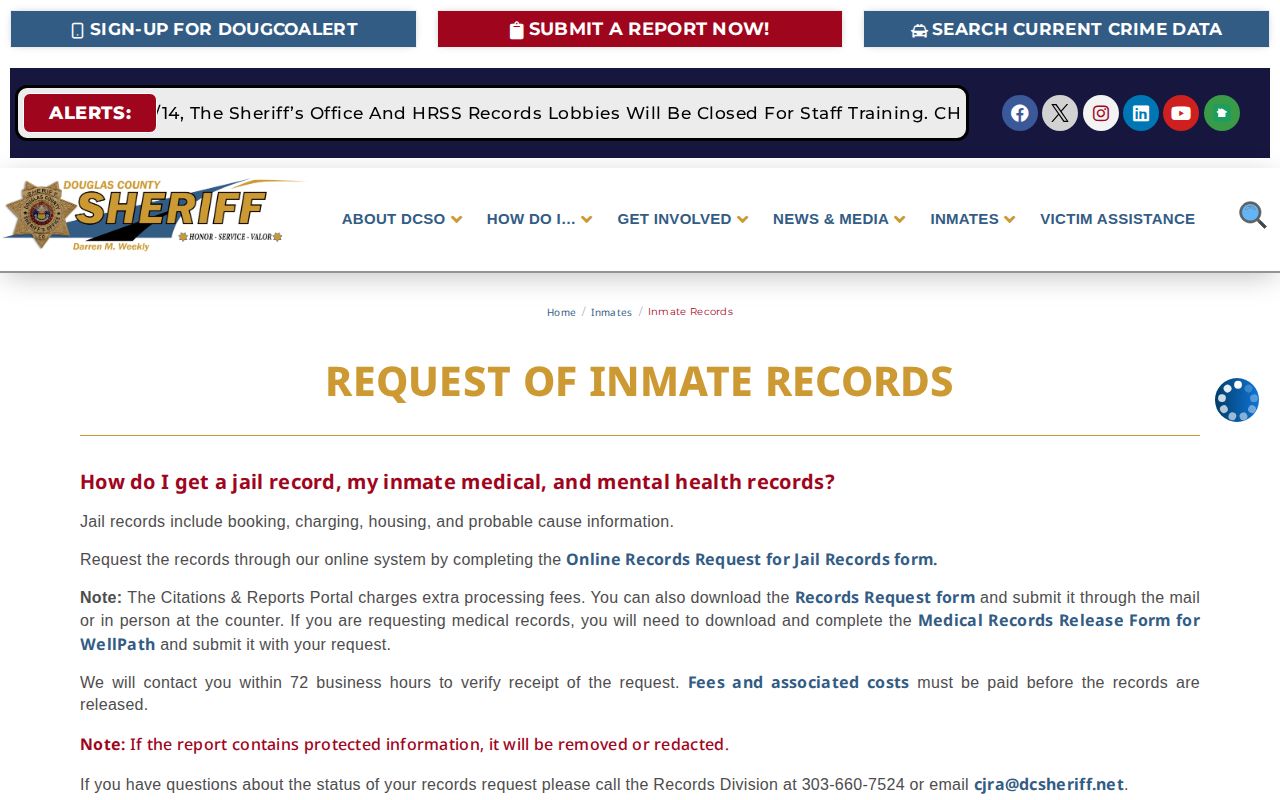
- Submit a DCSO jail records request when you need a documentable release record. DCSO says it will contact the requester within 72 business hours to verify receipt of inmate-records requests.
For a same-day custody question, use Jail Releases: 24 Hours. For a named-person lookup that may involve CDOC, parole, probation, federal custody, or ICE, start with the home page.
What a 72-Hour Review Shows
Douglas County's three-day release review is assembled from several official channels. The field table below shows what to collect while checking the last 72 hours.
| Field | What It Shows |
|---|---|
| Search date and time | When you checked the current Inmate Inquiry, which matters if the person appears on one day and disappears later. |
| Prior booking identifiers | Name, Global ID, booking number, or other identifiers that help DCSO records staff locate the jail record. |
| Current-custody result | Whether the person still appears as being held in the Douglas County Jail at the time of search. |
| VINE custody event | Whether VINE shows or notifies a release or transfer from the Douglas County Sheriff's Office Detention Center. |
| Court event | Bond, court order, disposition, sentence, probation, or next-hearing information that explains the custody change. |
| Jail records response | DCSO's formal booking, charging, custody-location, probable-cause, or release-related record once requested and processed. |
DCSO Records Are the Backstop
The DCSO inmate records page is the key source when a person no longer appears online and a documented release record is needed. DCSO says jail records include booking, charging, custody-location, and probable-cause information, and its records pages route inmate jail or medical records through the "Jail Records Request" option.
The 72-business-hour DCSO timing is a records-request acknowledgment or processing reference from the records pages. It is not an official 72-hour released-inmate list and should not be read as one.
Weekend and Holiday Releases
A 72-hour check is useful when a person may have been released late Friday, over a weekend, or near a holiday. In that situation, a current-custody result may change before court documents or records staff communication catches up. Record the search times, check VINE for a custody event, and search the Douglas County docket again on the next business day if a bond hearing, disposition, or review is likely to explain the release.
If the person was ordered to pretrial supervision after release, Douglas County Community Justice Services says intake is required within 24 hours of release from custody. That local rule can explain why a bond release has an immediate follow-up requirement, but it is not a public list of who was released.
For a three-day review, check the court record more than once. A weekend release may appear first as a custody change, then later as a bond condition, continued hearing, sentence entry, or probation referral. If the person was moved rather than released, the first clear clue may be a transfer notation in the jail record or a new custody result in CDOC, BOP, ICE, or another county's system.
No Official 72-Hour Feed Found
The research did not find a distinct DCSO 72-hour release list, recent-release archive, or app listing that advertises inmate releases. The Douglas County Sheriff app listings describe public-safety news, resident communication, tips, and reporting features, while the Detentions Demographic Statistics page recommends Microsoft Power BI mobile viewing for an interactive report. Those sources should not be described as a release feed unless a future inspection confirms that feature inside the app or report.
For documentation, use DCSO records. For alerts or near-real-time custody changes, use VINE. For the legal reason behind the release, use court dockets and official court records.
Released or Moved Elsewhere
A person who disappears from the Douglas County current-custody inquiry may have left the jail, but the next destination matters. Release to the community, bond with pretrial supervision, sentence completion, transfer to CDOC, transfer to another county, federal custody, ICE custody, hospitalization, and restricted record visibility can all produce different public-record paths.
For state-prison custody, parole, or discharge, use the CDOC Offender Search. For federal custody, use BOP when the case is federal. For immigration detention, use ICE channels when the record shows an immigration hold or transfer. For local jail release confirmation, keep DCSO jail records and Douglas County court records at the center of the review.
A 72-hour window is useful because it captures more than one business rhythm. Jail processing, VINE notification timing, court docket updates, and records-office contact do not always happen at the same pace. Keep the exact search dates, the name spelling used, and any booking identifiers so later records staff or court staff can match the right event.
For Douglas County, the three-day review should also separate a release from a statistics update. The detention demographic report and Power BI viewing note can help users understand current jail data, but those tools do not replace a jail-record request when the question is who left custody and why.
If the search involves a common name, carry the booking date, court number, and arresting agency through each check.